Is RCEP going to affect Taiwan or your business?
Analysis of how the Regional Comprehensive Economic Partnership (RCEP) trade agreement might affect Taiwan and its business relationships with Japan, Korea, and China.
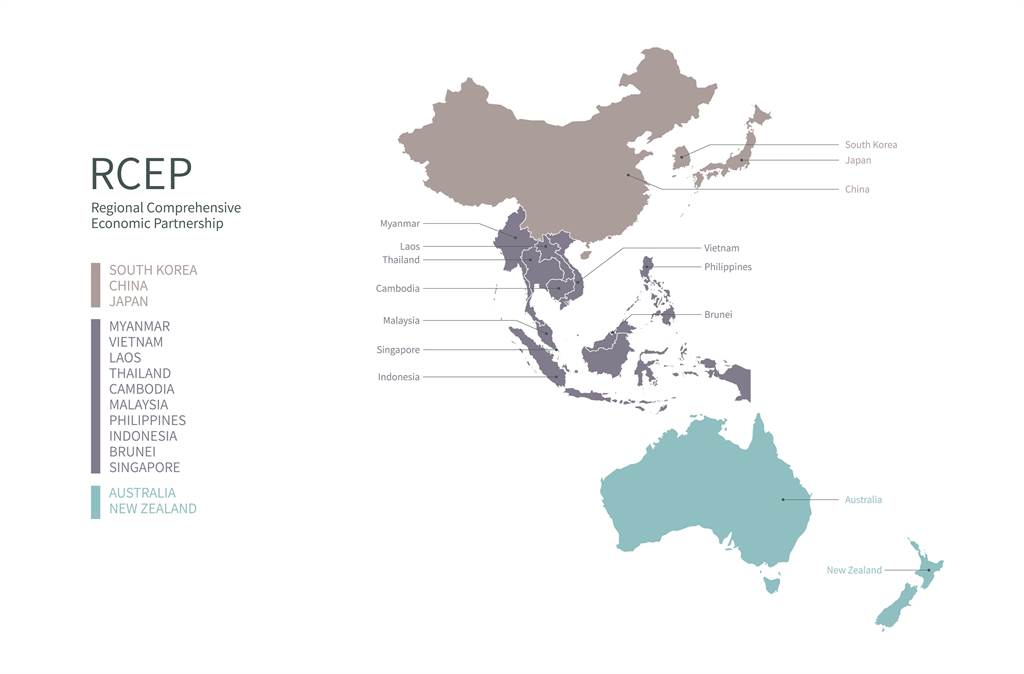
RCEP (Regional Comprehensive Economic Partnership) was signed in November 2020. Unsurprisingly, Taiwan was not included given the tense relationship between China, Taiwan, and the USA.
After 8 years of negotiations, the agreement was signed by 15 Asia-Pacific nations:
- Australia
- Brunei
- Cambodia
- China
- Indonesia
- Japan
- Laos
- Malaysia
- Myanmar
- New Zealand
- Philippines
- Singapore
- South Korea
- Thailand
- Vietnam
India was initially included but pulled out due to concerns that the free trade agreement might harm their local businesses through overlapping products and price competition with China.
Why is RCEP important?
The 15 member countries account for about 30% of the world’s population (2.2 billion people) and 30% of global GDP ($26.2 trillion) as of 2020, making it the biggest trade bloc in history.
Key Benefits of RCEP
-
Tariff-free Trade
- While not immediately effective, tariffs are expected to be lowered gradually over a 10-year period.
-
New Rule of Origin
- Previously, product origin was complex as items weren’t manufactured in single countries
- RCEP simplifies this by treating all products within member countries equally
- This incentivizes companies to seek suppliers within the trade region
-
GDP Growth Potential
- Expected GDP growth within member countries once the agreement is fully implemented
- Regional economic integration should foster increased trade and investment
Impact on Taiwan
Taiwan isn’t part of this epic bloc, but how significant is this exclusion? Let’s examine Taiwan’s current trade position:
Existing Trade Agreements
- 70% of Taiwan’s exports are already tariff-free, especially integrated circuits, semiconductors, and ICT products protected under ITA and ITA 2
- 30% of exports face tariffs, primarily in machinery, petrochemical, and textile industries
- Bilateral trade agreements exist with Japan, South Korea, and China
Trade Volume with RCEP Members (2019)
- Mainland China: US$91.8 billion
- Japan: US$23.1 billion
- South Korea: US$16.9 billion
Industry Impact
- Machinery and petrochemical industries likely to be affected
- Textile industry may see less impact
- Machine tools exports to China (including Hong Kong) were US$903 million in 2019
- Taiwan is Asia’s 4th largest gasoline exporter, after China, India, and South Korea
Why Taiwan Might Not Need to Worry (Yet)
1. Manufacturing Relocation
Most machinery and textile manufacturers have already moved to low-cost countries like Cambodia and Vietnam. Companies maintain headquarters in Taiwan but operate factories elsewhere. Recent withdrawals from China mostly relocated to Vietnam, not back to Taiwan.
2. Petrochemical Industry Evolution
The petrochemical industry faces challenges beyond RCEP, including:
- Environmental concerns
- Global competition pressures
- Manufacturing capacity constraints
- Tightening regulations The industry is already pursuing upgrades and relocation strategies regardless of RCEP.
3. Gradual Implementation
- No immediate tariff reductions for key industries
- 10-year implementation period provides time for adaptation
- Opportunity to accelerate industrial transformation and innovation
Key Questions for the Future
-
U.S. Policy Impact
- Will the USA maintain its aggressive stance toward Chinese trade?
- Possibility of U.S. rejoining CPTPP (Comprehensive and Progressive Agreement for Trans-Pacific Partnership)?
- How can Taiwan protect industries and reduce Chinese impact on global supply chains?
-
India’s Role
- Will India work more closely with Taiwan to limit RCEP’s impact?
- Concerns about China using RCEP to bypass pricing controls
- Potential for dumping low-cost Chinese products in member countries’ markets
-
Winners and Losers
- Does RCEP bring only benefits to its signatories?
- Who will emerge as the biggest winner - China, Japan, or Korea?
- Long-term implications for regional trade dynamics
Looking Forward
While RCEP presents challenges for Taiwan, the impact may be less severe than initially feared. The gradual implementation timeline provides opportunities for adaptation and transformation. Taiwan’s strong position in high-tech manufacturing and existing tariff-free arrangements for many products provide a buffer against immediate impacts.
The key will be using this transition period to:
- Accelerate industrial innovation
- Develop new business models
- Strengthen existing trade relationships
- Explore new market opportunities
References